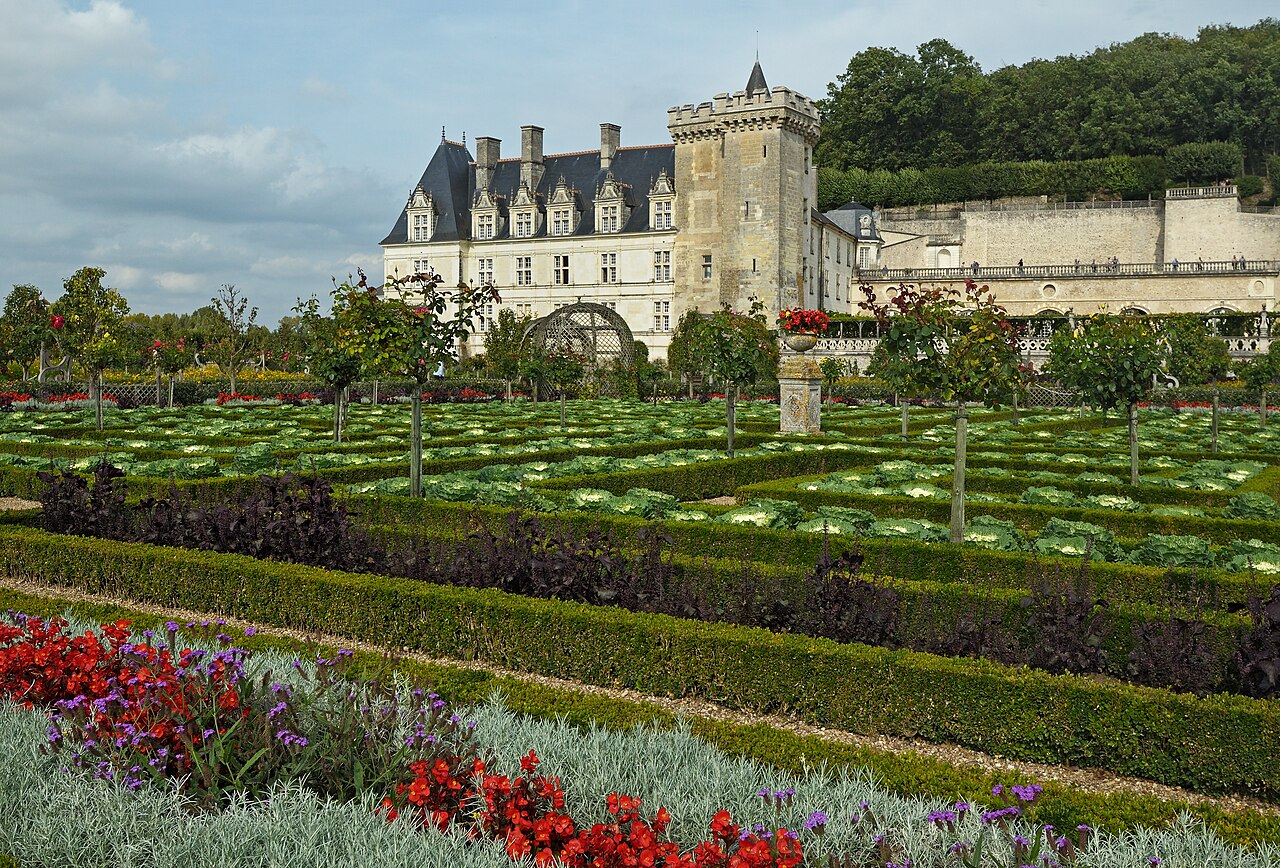
What is a "formal French" garden?
Before setting off to discover it, let us understand what we are going to see. The formal French garden, or regular garden, is an art of symmetry and control. Everything is ordered from a central viewpoint, often the château: straight avenues, calculated perspectives, parterres laid out to the line. The "embroidery" of clipped box forms arabesques on a background of gravel or flowers, like lace laid upon the ground. Topiary sculpts yew and box into cones, balls and pyramids. Born in Italy during the Renaissance and perfected in France by Le Nôtre at Versailles, this style finds in the Loire Valley some of its finest examples, on a human scale and often more intimate than the great royal gardens of Paris.
Villandry: the absolute benchmark
If you were to see only one, it would be Villandry, around 1h30 from Meung-sur-Loire. Its gardens rank among the most famous in Europe and embody the formal French garden in its most accomplished form. Across several levels unfold an extraordinary ornamental kitchen garden, where the vegetables draw coloured chequerboards, an ornamental garden whose box embroidery evokes the figures of love, and a soothing water garden. The symmetry is perfect, the perspectives admirable, the upkeep impeccable. Climb up to the terraces or the belvedere to grasp the whole of the design: it is from above that the magic truly works. Allow at least 1h30 in the gardens, more if you are an enthusiast.
Chenonceau: the gardens of Diane and Catherine
At Chenonceau, around 1h10 from Meung-sur-Loire, two formal French gardens face each other on either side of the château of the Ladies, and each bears the name of a great female figure. The garden of Diane de Poitiers is the larger and more structured, arranged around a central fountain, with its parterres framed by box and its clipped yews. The garden of Catherine de Médicis, more intimate, offers a pretty view of the gallery spanning the Cher. In spring and summer, the beds overflow with flowers renewed each season by the estate gardeners; in autumn, it is the structures of box and yew that take over, in a pared-back graphic style. A perfect setting before or after the interior visit.
Chamerolles: the Renaissance garden near Orléans
More confidential and closer to us, the Château de Chamerolles, in the Loiret to the north of Orléans, truly deserves the detour for its reconstructed Renaissance garden. Laid out in geometric parterres edged with box, it is arranged around pools and pavilions, in the spirit of the gardens of the sixteenth century. The château also houses an original museum of perfume, which extends the scented stroll beautifully among the beds of aromatic plants. It is an ideal visit to complement the great sites, less busy, within reasonable distance of Meung-sur-Loire. Check the opening days and times before you come, as they are more restricted than those of the most famous châteaux. A lovely gem for those who like gardens without the crowds.
Beauregard and the other remarkable gardens
The Loire Valley abounds in other gardens worth a look. Beauregard, near Cellettes, is known above all for its gallery of the Illustrious with its 327 portraits, but its park and its Garden of Portraits, planted by colour, appeal to lovers of botany. More widely, the region counts many accredited "Remarkable Gardens", from historic kitchen gardens to landscaped parks. If the regular garden and symmetry are your passion, round off your circuit with these less-frequented sites, often attached to smaller châteaux. You will find there the same rigour of design, in a quieter atmosphere, sometimes with the gardener in person to answer your questions about the clipping and the varieties.
The best season to visit them
The question comes up endlessly, and my answer is nuanced. For flowers and the profusion of colour, aim for late spring and summer, from May to September: Villandry and Chenonceau are then at the peak of their bloom. For the pure beauty of the structures, of the box embroidery and the topiary, autumn and even winter reveal the graphic skeleton of the gardens, once the flowers fade. The morning and late afternoon offer the finest light, low and raking, ideal for photography and for avoiding the crowds. Avoid the May bank holidays at the great sites. In short, there is no bad season for the formal French garden: it simply changes its face.
Planning a gardens circuit from Meung-sur-Loire
Here is how I suggest arranging all this from La Maison du Château. Devote a full day to the west, towards Villandry, possibly combining it with Azay-le-Rideau or Chenonceau, the distances allowing it provided you set off early. Keep a closer half day for Chamerolles, to the north of Orléans, more peaceful. Slot Beauregard into a Chambord–Cheverny day, since it lies nearby. Do not overload: two major gardens a day are enough to savour them without saturation. And make the most of the return to the house, at the heart of the Valley 1h30 from Paris, to leaf through your photos on the terrace while planning the next day's stage.
From the embroidery of Villandry to the gardens of the Ladies at Chenonceau, the Loire Valley offers enthusiasts a unique anthology of formal French gardens. Symmetry, clipped box, learned perspectives: each season reveals a new facet. From La Maison du Château in Meung-sur-Loire, you radiate out to these landscape masterpieces, at the heart of a World Heritage region, 1h30 from Paris.