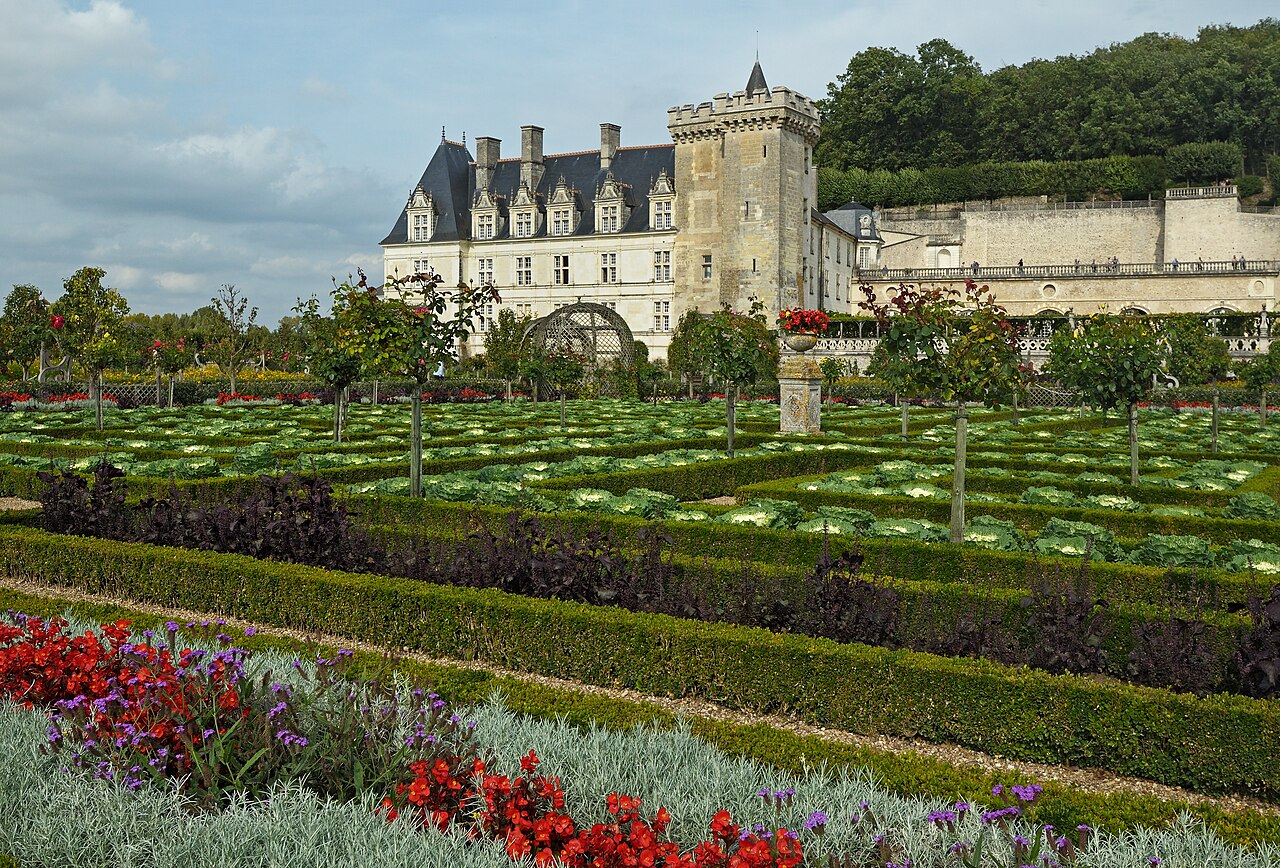
Why Villandry is France's most famous Renaissance garden
Built around 1536, Villandry was the last of the great Renaissance châteaux raised on the banks of the Loire. Yet its worldwide fame rests not on its architecture, sober and elegant, but on its gardens, recreated in the early 20th century by Doctor Joachim Carvallo and his wife Ann Coleman. They restored the spirit of 16th-century gardens from old engravings, sweeping away the English-style park inherited from the 1800s. The result is unique: six hectares of box embroidery, colourful vegetables and roses, laid out on stacked terraces. No other Loire garden achieves this geometric perfection, and few places in France draw garden lovers from so far afield.
The ornamental kitchen garden: nine squares, a million colours
This is Villandry's signature. The potager occupies nine squares of equal size, each planted to a different geometric pattern and edged with box clipped to the line. Ornamental cabbages, purple chard, aubergines, leeks and carrots are chosen for their colour and replanted twice a year, in spring and summer. It is the legacy of medieval monastic kitchen gardens crossed with the Italian art of the Renaissance. More than 40 species grow here in chequerboards of blue, red and green. Seen from the upper terrace or the keep, the whole forms a living mosaic that changes its face with every season, from spring leeks to autumn squashes.
The ornamental garden and the love garden in box embroidery
Above the kitchen garden lies the ornamental garden, including the famous love garden. Four box parterres tell of four kinds of love: tender love (hearts and flames), passionate love (hearts broken by passion), fickle love (horns and love letters exchanged), and tragic love (the blades of daggers and swords). It is a symbolic reading typical of the Renaissance, where each bed delivers a message. Nearby, the music garden evokes lyres and harps shaped in box. This living script demands painstaking clipping: the gardeners of Villandry maintain more than 50 kilometres of box hedging by hand, an extraordinary feat of patience repeated season after season.
The sun garden, the maze and the water garden
Villandry does not stop at the lower terraces. Higher up, the sun garden, created in 2008, unfolds three green rooms: the sun room with its central star, the cloud room and the children's room. The hornbeam maze, simple and family-friendly, leads to a central platform overlooking the design. Finally, the water garden, classical and soothing, is arranged around a large cross-shaped mirror fed by the original hydraulic system. It is the calmest spot on the estate, perfect for a pause in the shade of the limes after the riot of colour in the kitchen garden. Each level rewards the climb with a fresh perspective over the whole composition.
Opening hours, prices and the best season to visit Villandry
The gardens of Villandry are open all year, the château from mid-February to mid-November. In high season the gates open around 9am and close in the evening, later in summer. Expect roughly 13 euros for the gardens alone and around 15 euros for the combined château and gardens ticket, with free entry for young children. The best time runs from May to September, when the summer planting peaks and the roses bloom. April offers the first embroidery, October the autumn squashes. Always check the exact hours on the official website, as they vary from week to week throughout the season.
Our visiting tips: light, the keep and avoiding the crowds
Climb the keep or the belvedere terrace first: the bird's-eye view over the parterres is essential to grasp the overall composition. The raking light of morning and late afternoon sculpts the box and makes the colours glow, while harsh midday sun flattens the volumes. Allow two hours to wander without rushing, more if you picnic outside. Villandry is less crowded than Chenonceau, but the coaches arrive mid-morning: an early start from our house gives you the paths almost to yourself. Most of the gardens are accessible to pushchairs and wheelchairs, making this an easy outing for families and grandparents alike.
Combining Villandry with Azay-le-Rideau and Langeais in a day
Villandry forms a perfect trio with two Renaissance neighbours. Azay-le-Rideau lies about fifteen minutes to the south: its château set on the Indre complements the gardens of Villandry beautifully. Langeais, to the west, adds the medieval dimension with its fortress and drawbridge. A fine day means opening Villandry at 9am, a light lunch on site or in Azay, then a second site in the afternoon. Avoid attempting all three in one day if you want to savour them: two châteaux properly seen beat three rushed. The south bank of the Loire lends itself wonderfully to this slow approach to travel.
How to reach Villandry from Meung-sur-Loire
From our base in Meung-sur-Loire, Villandry is about an hour's drive via the A10 motorway towards Tours, then along the banks of the Indre and the Cher. The on-site car park is large and free. By train, the simplest route is to reach Tours and then hire a bike or a car, as Villandry has no station of its own; the Loire à Vélo cycle route passes close by for cyclists. Setting off in the morning lets you arrive before the groups and enjoy the cool air over the parterres. It makes an ideal day trip from our house, easy to pair with a second south-bank château.
Villandry proves that the finest spectacle in the Loire can be horticultural. From La Maison du Château in Meung-sur-Loire, allow an hour's drive: set off early, climb to the belvedere, and let the mosaic of the kitchen garden dazzle you. It is one of our favourite outings to recommend to our guests.