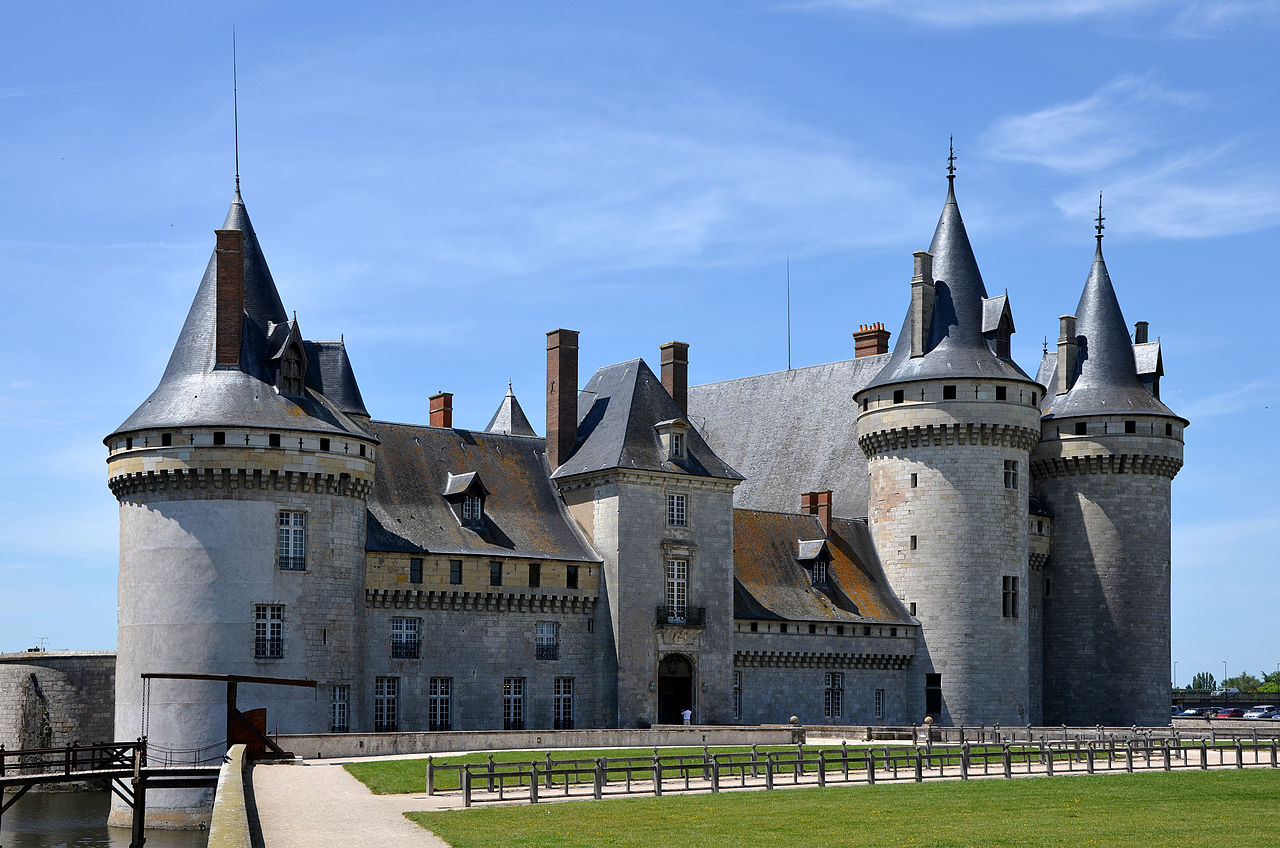
A true medieval fortress with a water-filled moat
Forget for a moment the pale stone façades and the mullioned windows of the Renaissance: Sully-sur-Loire is the picture-book vision of a castle. Four stout round towers crowned with pointed roofs, thick curtain walls, and above all a broad moat of running water that wraps entirely around the building. The reflection of the keep in the water, in the early morning, is one of the loveliest sights in the Loire Valley. Built at the end of the fourteenth century by Guy de La Trémoille to guard a strategic crossing on the river, the fortress has kept its defensive bearing intact. You cross the bridge, pass beneath the entrance vault, and slip into another age. For children and history lovers alike, it is an instant favourite.
The keep’s roof timbers, a masterpiece of carpentry
The highlight of the visit waits right at the top of the keep. The fourteenth-century roof frame is one of the best preserved in Europe, and one of the most impressive you will ever see inside a château. Picture an upturned wooden cathedral: a forest of oak beams assembled into a broken cradle vault, without a single nail, standing for more than six centuries. The carpenters of the day cut each piece by hand and numbered the joints with a chisel, marks still legible today. You tilt your head back and stand speechless before the sheer technical feat. Do take the time to climb the stairs: the reward is well worth the effort, and the coolness of the timber is welcome in summer.
Maximilien de Béthune, the great minister of Henri IV
The château owes its name to its most illustrious owner: Maximilien de Béthune, better known by his title of Duke of Sully. The faithful right-hand man of Henri IV and superintendent of finances, he bought the estate in 1602 and left his mark on it. It was he who fitted out the interiors, strengthened the defences and made the domain the seat of a dukedom. He is credited with the saying “Tillage and pasture are the two breasts that feed France”, a neat summary of his economic policy turned towards farming. His presence still lingers in the rooms, and the visit sheds welcome light on that pivotal moment when France emerged from the Wars of Religion to rebuild itself under good King Henri.
Voltaire in exile, when Sully hosted the Enlightenment
For a few seasons, Sully-sur-Loire was also a refuge for free thought. The young Voltaire, banished from Paris after his impudence towards those in power, stayed here several times in the early eighteenth century, a guest of the duke of the day. Far from brooding, he turned the château into a theatre: his early plays were staged here, brilliant parties were thrown, and there was a great deal of laughter. These worldly, literary episodes add an unexpected layer to a place one imagines as purely military. The defensive fortress became, for the span of a reign, a salon of the Enlightenment on the banks of the Loire. I love sharing this anecdote with my guests: it changes the way one looks at the old stones.
The park, the moat and a riverside stroll
Beyond the walls, the estate opens onto a pleasant park that invites a stroll once the visit is over. You follow the moat, take in the château from every angle, and hunt for the best spot for a photograph. The contrast between the stony mass of the fortress and the softness of the foliage is striking. It is also a perfect place to picnic in the shade, let the children stretch their legs, or simply catch your breath between two stops on a busy trip. The Loire flows just a few steps away: extend the walk down to the banks to grasp why this site was, for centuries, such a coveted lock on the royal river.
The Sully music festival, a June rendezvous
If you are staying in the area in late spring, look out for the classical music festival that enlivens Sully-sur-Loire and the wider Loiret in June. Born in the 1970s, it fills the exceptional setting of the château and the surrounding churches with symphonic concerts, chamber music and recitals. Hearing a string quartet in a medieval hall, or a full orchestra at the foot of the towers, turns a simple visit into a memorable occasion. Programmes are announced through the year on the official county council website: do book ahead, as the most sought-after evenings sell out quickly. It is the ideal chance to pair heritage with musical emotion.
Sully with children: the castle of their dreams
Of all the châteaux on the circuit, Sully-sur-Loire is probably the one that speaks most naturally to children. The moat, the towers, the arrow slits, the entrance bridge: the whole imagery of the Middle Ages is right there, concrete and tangible. The spiral staircases, the guard rooms and the climb up to the roof frame all feel like an adventure. The park lets everyone unwind afterwards, and the whole thing fits comfortably into half a day, which suits younger visitors well. No endless queue, no oppressive crowd: it is a relaxed family outing, where you learn almost without noticing. A reliable winner every time for my guests travelling with children.
How to get there and how long to allow
Good news for anyone staying with us: Sully-sur-Loire is the closest château to La Maison du Château, just 35 minutes away by road, heading up the Loire to the east via Châteauneuf-sur-Loire. It is the ideal outing for a quieter morning, or for the end of the day. Allow around an hour and a half for the interior, more if you linger in the park or picnic on site. Parking is easy near the château. Feel free to combine Sully with the nearby basilica of Cléry-Saint-André or the abbey of Saint-Benoît-sur-Loire, for a day devoted to Loire heritage without ever driving far from the house.
Sully-sur-Loire is the castle you drew as a child, made real: water-filled moats, dizzying roof timbers, the ghosts of Sully and Voltaire. And because it is the closest to La Maison du Château in Meung-sur-Loire — barely 35 minutes — it is often the first outing I suggest to my guests as a gentle way into the Loire Valley.