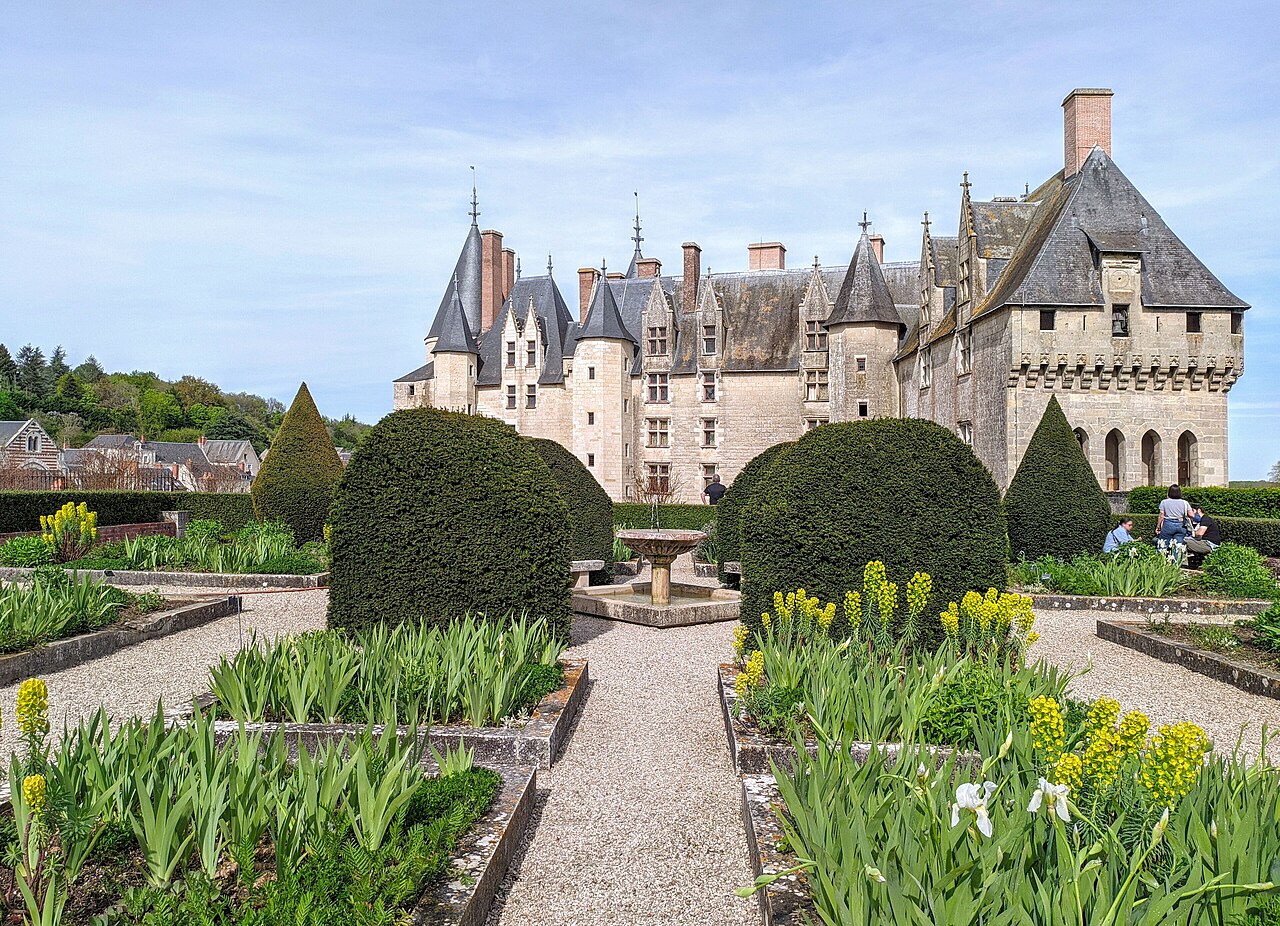
Langeais, a château of two faces between Middle Ages and Renaissance
Langeais surprises with its dual character. On the town side it is an austere fortress: high walls, round towers topped with pepper-pot roofs, a wall-walk, and one of the few drawbridges still in working order in the Loire Valley. On the courtyard and garden side, the residence turns gentler, pierced with mullioned windows and crowned with carved dormers. This duality tells of a pivotal age: built quickly around 1465 under Louis XI, Langeais belongs to the end of the military Middle Ages while heralding the comfort of the Renaissance. It is one of very few great Loire châteaux raised in a single campaign, with no major later alteration, which gives it a rare coherence.
The keep of Foulques Nerra, the oldest in France
In the park, behind the château, stand the ruins of a stone keep regarded as one of the oldest in France, perhaps in Europe. It was raised around the year 1000 by Foulques Nerra, the fearsome Count of Anjou nicknamed the Black Falcon, a tireless builder of fortresses. This rectangular keep bears witness to the military architecture of the early feudal age, long before round towers and pleasure palaces. The contrast is striking between this austere 11th-century mass and the 15th-century château. The climb to the remains is rewarded with a fine view over the Loire valley and the town of Langeais below, a quiet vantage point few visitors take the time to seek out.
The marriage of Charles VIII and Anne of Brittany in 1491
Langeais owes its fame to a decisive event in French history. On 6 December 1491, in the great hall of the château, the young King Charles VIII married Anne, Duchess of Brittany. This marriage, negotiated in haste and secrecy, sealed the gradual union of the Duchy of Brittany with the Kingdom of France, ending centuries of Breton independence. The match was arranged for political reasons, yet it lastingly redrew the map of the realm. No other Loire château can claim a wedding so weighty for national unity. It is this scene that Langeais has chosen to bring to the fore at the heart of its visit, in the very hall where the ceremony took place.
The waxwork scene of the royal wedding recreated life-size
To bring the event to life, Langeais has installed a life-size waxwork recreation in the wedding hall. There you see Charles VIII, Anne of Brittany in her ceremonial gown, the witnesses and the court, frozen in the solemn moment of 1491. Embroidered costumes, period furniture and a hushed atmosphere make the scene especially popular with children and give substance to a chapter of history that is often abstract. The staging is old-fashioned in concept yet effective, setting Langeais apart from more austere visits. Around this hall, the furnished apartments display a remarkable set of 15th and 16th-century tapestries, along with chests and four-poster beds from the late Middle Ages.
The wall-walk, the drawbridge and the tapestries
A visit to Langeais holds several concrete pleasures. The drawbridge still works and is operated during demonstrations: watching the portcullis descend recalls the defensive purpose of the place. The wall-walk, running along the ramparts on the town side, is followed at the height of the machicolations and gives a plunging view over the street. Inside, the collection of Flemish and French tapestries is one of the finest in the Loire, with hunting scenes, verdures and allegories of great delicacy. The monumental fireplaces, some painted, punctuate the rooms. Together they form a coherent medieval setting, rare for a château open to visitors and all the more memorable for it.
The wooded park and the treehouse for families
The park of Langeais, planted with ancient trees, slopes gently behind the château down to the ruins of the keep. It is a space made for strolling and picnicking in the shade of the great cedars. For families, a large treehouse delights children and pleasantly rounds off the visit to the rooms. Information panels along the way explain the history of the site, from the keep of the year 1000 to the 15th-century château. Crossing the park naturally links the military medieval part and the residential Renaissance part. Allow half an hour of walking in addition to the interior visit to make the most of the estate and its quiet corners.
Hours, prices and the recommended length of visit at Langeais
Langeais is open all year, with longer hours in high season and reduced hours in winter. Admission for an adult is around 13 euros, with free entry for young children and family rates available. Allow roughly 1.5 to 2 hours to enjoy the château, the tapestries, the wedding scene, the wall-walk and the park with its keep. The town of Langeais, crossed by its shopping street, offers a few places to lunch a stone's throw from the entrance. As ever, check the exact hours and the day's demonstrations, in particular the working of the drawbridge, on the official website before you set off.
Reaching Langeais from Meung-sur-Loire and combining the visit
From our base in Meung-sur-Loire, Langeais is about 1h10 by road via the A10 then the north bank of the Loire towards Tours and Saumur. The town has a station on the Tours-Saumur line, which makes the château reachable by train for car-free travellers, a few minutes' walk away. Langeais combines ideally with Villandry and Azay-le-Rideau, all close together on the south bank: a Renaissance-and-Middle-Ages themed day comes into its own. For wine lovers, the Bourgueil vineyard is not far. Leave the house in the morning to open the day with the fortress, more impressive in the soft light of early morning.
Langeais offers in a single place the medieval fortress and Renaissance splendour, crowned by the wedding scene that joined Brittany to France. From La Maison du Château in Meung-sur-Loire, allow 1h10 by road: we love it as a trio with Villandry and Azay, for a day that spans five centuries of history.