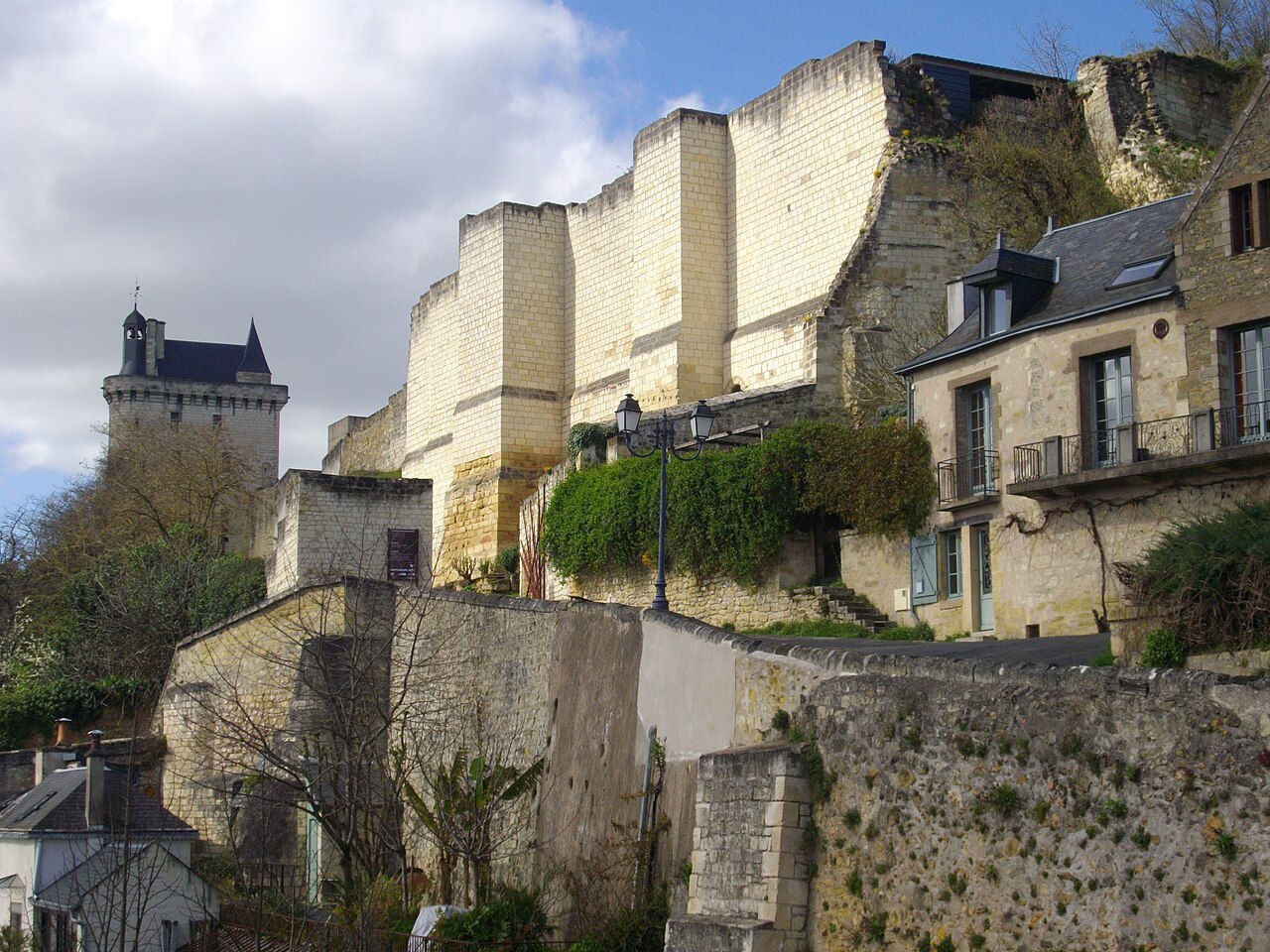
The royal fortress of Chinon, sentinel above the Vienne
Chinon is not a pleasure palace but a true medieval fortress, stretched over 400 metres along the crest of a rocky spur above the Vienne. Three fortified sets follow one another: Fort Saint-Georges to the east, the Middle Castle at the centre, and Fort du Coudray to the west, separated by former dry moats. This strategic position commanded the valley and the river crossing. The ramparts, towers and curtain walls bear witness to several centuries of military architecture, from the Counts of Anjou to the Plantagenets and then the kings of France. From the town below, the massive silhouette of the fortress, floodlit at night, forms one of the finest sights of southern Touraine.
Joan of Arc meets Charles VII at Chinon in 1429
In late February 1429, a young woman from Domrémy arrived at Chinon, where the dauphin Charles, the future Charles VII, had taken refuge in the midst of the Hundred Years' War. On 25 February she was received by the dauphin. Legend has it that he hid among his courtiers to test her: Joan of Arc is said to have recognised and singled him out without hesitation, in the great hall of the Middle Castle. This meeting marked the start of the Joan epic that would lead to the coronation of Charles VII at Reims. Today only the chimney wall of the hall where the scene took place survives, yet the place remains one of the most history-laden in France. Chinon rightly claims this founding page of the kingdom's recovery.
The interactive trail on a digital tablet
Restored over the past two decades, the fortress offers a modern, immersive visit. A digital tablet, the Histopad, is handed out at the entrance: pointing it around certain rooms reveals the lost settings reconstructed in augmented reality, the great 15th-century hall, the royal apartments, the atmosphere of the court. Treasure hunts and content for children round out the experience, making the visit lively for families. This staging makes up for the partly ruined state of some buildings by showing again what once was. It is one of the most accomplished digital schemes among the Loire châteaux, best discovered tablet in hand, room after room, at your own pace.
The Coudray tower, the Templars and their graffiti
At the western tip of the fortress, the Coudray tower holds a singular memory. In 1308, several dignitaries of the Order of the Temple, including the Grand Master Jacques de Molay, were imprisoned here on the orders of Philip the Fair during the fall of the Templars. On the walls of their cell you can still make out graffiti carved by the prisoners: crosses, hearts, religious motifs. These moving traces, seven centuries old, make the Coudray tower one of the most mysterious spots in the fortress. The climb also offers a fine view over the valley. It is an essential detour for lovers of medieval history and esoteric symbols, and a quietly haunting moment in the visit.
The view over the Vienne and the medieval old town of Chinon
From the ramparts and gardens of the fortress, the panorama over the Vienne and the slate roofs of the old town is striking. Chinon has kept a rich medieval centre, with its half-timbered houses, cobbled lanes and ancient dwellings. At the foot of the fortress, the Grand Carroi and Rue Voltaire gather the finest façades. Rabelais, born nearby, immortalised the region in his work. After the château, walk down to wander the town: the stroll along the Vienne and a pause in a café of the old town pleasantly extend the experience. Town and fortress together form a heritage ensemble of great coherence, well worth a full half-day.
The Chinon vineyard and its cabernet franc reds
Chinon is not only a fortress, it is also a renowned wine appellation. The vineyard stretches over the slopes around the town and produces mainly red wines from cabernet franc, supple and fruity when young, more complex after a few years of ageing. A few rosé and white cuvées complete the range. Many estates welcome visitors for a tasting, often in troglodyte cellars dug into the tuffeau. After the château in the morning, a stop at a winegrower's in the afternoon is a fine way to extend the day. Appoint a sober driver and enjoy in moderation: Chinon ranks among the most appreciated reds of the Loire Valley.
Hours, prices and tips for visiting Chinon with children
The royal fortress of Chinon is open all year, with extended hours in high season. Admission for an adult is around 12 to 13 euros, with free entry for young children, and the Histopad tablet is generally included. Allow roughly 1.5 to 2 hours for the visit, more with children who linger over the digital treasure hunts. The site, long and partly in the open air, calls for good shoes and sun protection in summer. A panoramic lift links the town centre to the fortress, handy for avoiding the climb. Check the exact hours and the day's events on the official website before your visit.
Reaching Chinon from Meung-sur-Loire and planning the day
From our base in Meung-sur-Loire, Chinon is about 1h20 by road via the A10 towards Tours, then the Azay-le-Rideau direction and the Vienne valley. Chinon has a station served from Tours, allowing car-free travellers to reach it by train. The ideal day combines the fortress in the morning, lunch in the old town, then a tasting at a winegrower's or a stroll along the Vienne in the afternoon. For the keenest, Azay-le-Rideau sits on the way back. Leave the house early to enjoy the fortress before the crowds and the morning light on the Vienne, when the river is at its calmest.
Chinon brings together a spectacular fortress, the memory of Joan of Arc and a great vineyard: a concentrate of French history above the Vienne. From La Maison du Château in Meung-sur-Loire, allow 1h20 by road; we recommend it as a full day, the château in the morning and a tasting in the afternoon.