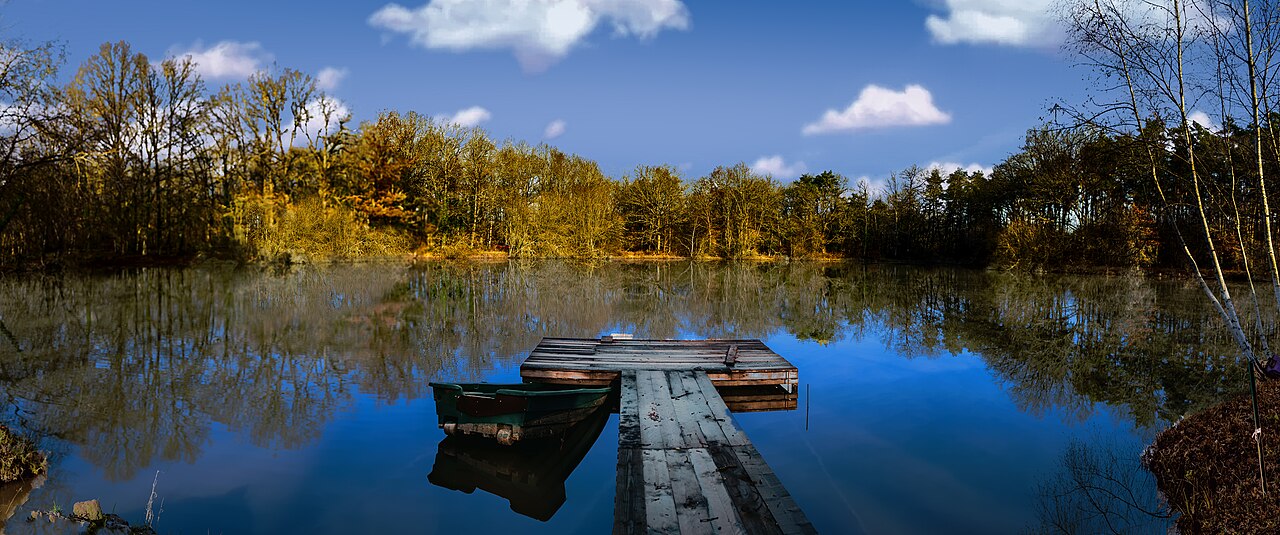
A vast woodland just north of Meung-sur-Loire
People rarely realise it, but the largest state forest in France is not in the east or the Landes: it spreads right on our doorstep. The Orléans Forest covers nearly thirty-five thousand hectares north of the Loire, in an arc around Orléans, from Châteauneuf-sur-Loire to Pithiviers. From La Maison du Château in Meung-sur-Loire, its first stretches of woodland are less than half an hour away. Unlike the better-known Sologne, the Orléans Forest stays confidential, almost secret. That is precisely its charm: you can walk for hours without meeting a soul, in unspoilt nature where wildlife abounds. A complete change of scene, a stone’s throw from the comfort of the house and an easy escape on any day of your stay.
The finest walking trails on foot
The Orléans Forest is criss-crossed with waymarked paths, forest rides and themed loops to suit every level. The Ingrannes area, around the Grandes Bruyères Arboretum, offers pretty family walks among heathers, magnolias and ancient oaks. Further east, the Lorris and Combreux blocks unfold long, straight rides ideal for big walks. The GR 3, the long-distance footpath that follows the Loire, brushes the forest and lets you link river nature with woodland nature. Bring an IGN map or a hiking app, as the forest is vast and the junctions look alike. In autumn, the carpet of leaves and the low, raking light turn every track into a painting and reward even a short outing handsomely.
The Combreux observatory: deer, storks and the rut
The forest’s naturalist jewel hides near Combreux: a birdwatching hide set on the edge of a pond, where in silence you can watch for black storks, herons, ospreys and many waterbirds. The Orléans Forest is in fact one of the few French sites where black storks nest, a shy and elusive species. In autumn the forest also rings with the stag’s rut: at dusk, in September and October, you can hear — and sometimes glimpse — these great deer. Always approach quietly, binoculars in hand, without disturbing the wildlife. It is a striking, deeply wild experience that I recommend to early risers and to bird lovers passing through the house. Wrap up well, and let the forest fall silent around you.
The forest ponds, havens of biodiversity
Scattered beneath the canopy, dozens of ponds punctuate the Orléans Forest and make it a sanctuary for wildlife. Once dug by monks or for fish farming, these stretches of water now host dragonflies, frogs, migrating birds and a rich aquatic flora. The Étang de la Vallée, near Combreux, is one of the most accessible: it offers a leisure base, a beach and trails that circle it, perfect for a quiet family walk. Other ponds, wilder, must be earned at the end of a forest track. The reflection of the trees on the still water, especially in autumn, ranks among the loveliest images the forest can offer. Do stay on the prepared banks to protect these fragile habitats for the years to come.
Mountain biking and long crossings for the sporty
With its hundreds of kilometres of flat, rolling forest rides, the Orléans Forest is a paradise for mountain biking and gravel. The long straight lines let you rack up the kilometres without major technical difficulty, ideal for sporty families and seasoned riders alike. Several waymarked circuits link the main blocks, and you can build your own loops from the many forest crossroads. The forest also lends itself to running and to long day-crossings. For my guests who travel with their bikes, it is a perfect alternative to the Loire à Vélo on windy days: sheltered by the trees, you pedal in calm. Just check the hunting periods before venturing off the main trails, and you will have the woods almost to yourself.
Mushrooms, wildlife and a forager’s secrets
In autumn the Orléans Forest becomes a foragers’ kingdom. Ceps, chanterelles, hedgehog mushrooms and many other species push up under the oaks and pines after the first September rains. Picking is tolerated for family consumption, in reasonable quantities and outside protected zones. A few golden rules: gather only what you can identify with certainty, respect the undergrowth, and have your harvest checked by a pharmacist if in doubt. Beyond mushrooms, the forest shelters roe deer, wild boar, foxes and a remarkable birdlife. It is an immersion in living, generous nature. I keep a few tips at the house on good spots and seasons for my foraging guests: just ask me, I am happy to share them.
Planning your forest outing from the house
A few precautions make the adventure more serene. Take water, walking shoes and a map or an offline app, as the signal is poor under the trees. In autumn and winter, be sure to find out the hunting days, posted at the town hall and at the entrance to the blocks, and stay on the waymarked paths. Dress in visible colours. The Orléans Forest has no ticket office: access is free and open, which makes it an ideal outing for smaller budgets or for days without a château booking. From Meung-sur-Loire, aim for the Combreux and Ingrannes areas for a first taste. And use the way back to follow the Loire: forest in the morning, river in the afternoon — that is a fine day in the open air.
Wild, silent and immense, the Orléans Forest reveals a side of Loire-valley nature that few travellers suspect. Deserted trails, shimmering ponds, black storks and the stag’s rut: less than thirty minutes from La Maison du Château, it is a green interlude I recommend to anyone wanting to breathe between two châteaux.