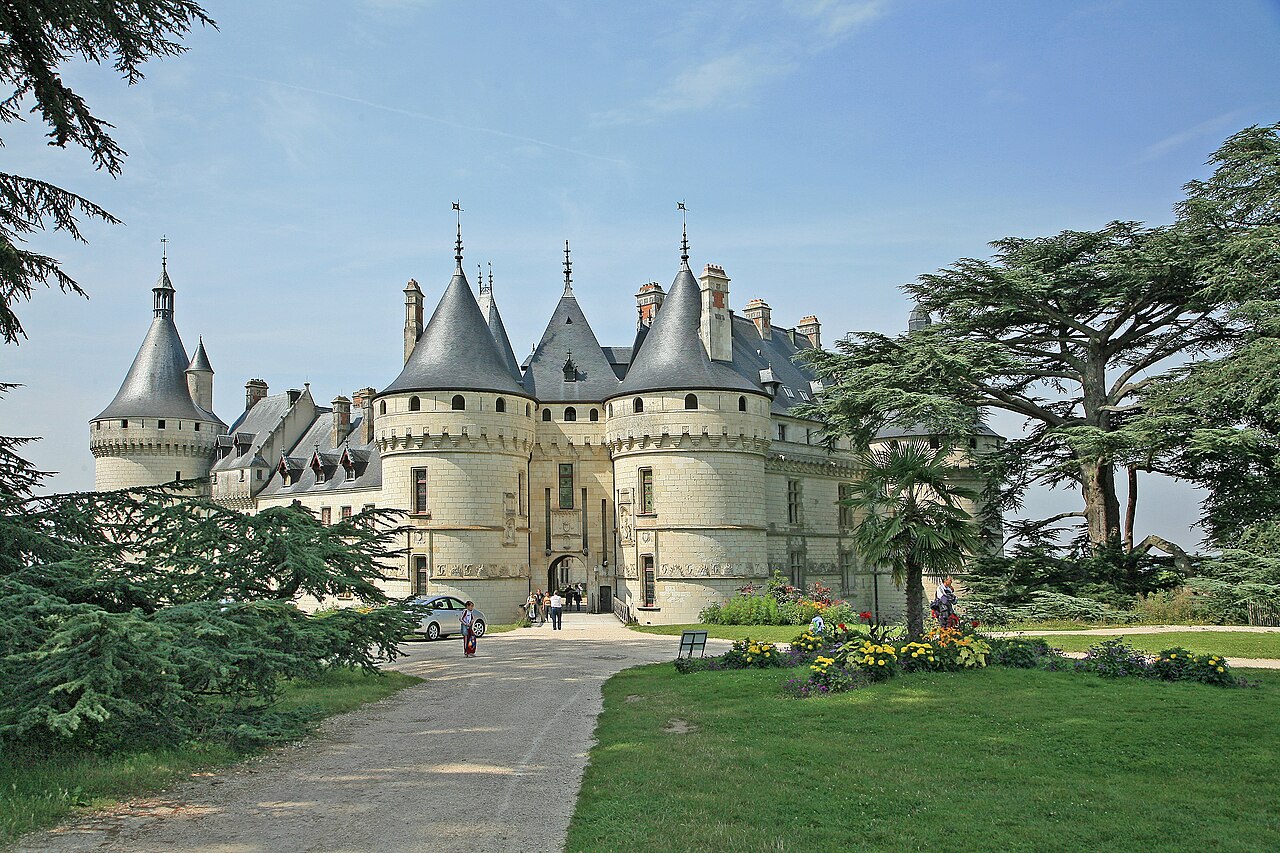
A château perched above the Loire
Even before you cross the threshold, Chaumont-sur-Loire impresses by its position. The fortress stands on a promontory above the river, offering one of the finest views in the whole valley. You climb up from the village along a shaded avenue, and the silhouette gradually reveals itself: drawbridge, round towers capped with conical roofs, wall-walk. The whole, rebuilt at the end of the fifteenth century, blends the defensive bearing of the late Middle Ages with the first graces of the Renaissance. From the terraces, the eye carries far over the Loire and its sandbanks. This marriage of proud architecture and open panorama gives Chaumont a presence that photographs struggle to convey. You really have to experience it on the spot.
Catherine de’ Medici and Diane de Poitiers: the famous exchange
Chaumont is inseparable from two great ladies of the Renaissance. Catherine de’ Medici acquired the château in 1550. But the most famous episode came after the death of Henri II: the queen, at last in control, forced the royal favourite Diane de Poitiers to hand her the sumptuous Chenonceau in exchange for Chaumont. Diane had little choice; she came to live here for a time, reluctantly, before withdrawing. You visit rooms that evoke this rivalry, and you sense how much this swap was a revenge as much as a transaction. For anyone drawn to court intrigue, Chaumont tells the flip side of the Chenonceau story, seen this time from the side of the victorious queen.
Refined interiors shaped by the Broglie family
The apartments you walk through today owe much to the château’s last golden age, at the end of the nineteenth century, under the Prince and Princess de Broglie. This wealthy family turned Chaumont into a prestige residence and entertained fashionable Paris here. Precious furniture, hangings, faience from the workshop set up on site, a state dining room: the décor breathes the splendour of an era that knew how to receive. You can even sense the memory of receptions held in honour of illustrious guests. This layering of periods — Renaissance, nineteenth-century romanticism, contemporary art today — makes the visit so rich. Chaumont is not frozen in a single moment: it reads like a palimpsest, layer upon layer.
The stables, a model of luxury for horses
Whatever you do, do not leave Chaumont without visiting its stables, regarded as among the finest and most modern of their day. Built at the end of the nineteenth century, they gave each horse unheard-of comfort: spacious stalls in fine wood, porcelain mangers, careful lighting, an elegant tack room, and even electricity before the château itself had it. The stable yard, the riding school and the carriage houses form a rare equestrian ensemble, a witness to the Broglie family’s passion for horses. Children love imagining the lives of these animals, pampered better than many people of the time. It is a part of the visit often overlooked, yet one of the most surprising and telling.
The art and nature centre, contemporary art at the château
Since the Region took it over, the domain has become an art and nature centre unlike any other in France. All year round, leading contemporary artists take over the château’s rooms, its outbuildings, the gallery and the park with often spectacular installations, playing on light, material and the living world of plants. You move from a Renaissance fireplace to a striking work of land art, and this dialogue between heritage and living creation is what makes Chaumont so distinctive. The exhibitions change regularly: no two visits are ever quite the same. Even if contemporary art does not appeal to you at first, let yourself be surprised: the harmony with the place is almost always apt and poetic.
Château and Garden Festival: telling the two apart
Let us be clear, because the confusion is common: the International Garden Festival and the château are two separate things, gathered on a single estate. The festival, created in 1992, sets out around twenty ephemeral gardens each year on a renewed theme, from April to November. It is world-famous, and fascinating. But the historic château, its apartments, its stables and its nineteenth-century park can be visited independently and are well worth the trip in their own right, including outside the festival season. The “estate” ticket usually gives access to the whole. My advice: do not rush off to the gardens without entering the château. You would miss the heart of the site’s history, and that would be a shame.
How long to allow and how to plan your day
Chaumont is a vast estate: allow a good half-day, or a full day if you also visit the Garden Festival. I recommend starting with the château and the stables in the morning, when the light is soft and the crowds are lighter, then devoting the afternoon to the park, the gardens and the artistic installations. A lunch break on the estate or in the village of Chaumont is a must. The terraces offer the best views over the Loire at the end of the day, as the sun sinks. Bring good shoes: the level changes between the village, the château and the park are all done on foot, and you walk more than you might expect.
Getting to Chaumont-sur-Loire from Meung-sur-Loire
From La Maison du Château, allow about 50 minutes by road, following the bank of the Loire to the south-west by way of Blois. The riverside route is superb and is already part of the pleasure. Parking is available near the estate. Chaumont pairs perfectly with a morning visit to Blois, the royal château being just a quarter of an hour away; you can thus take in two major sites in the same day without long driving. In high season, and especially during the Garden Festival, book your tickets online to avoid the queue. Leave the house early: you will enjoy the estate before the midday crowds arrive.
Chaumont-sur-Loire is three châteaux in one: the Renaissance fortress of the queens, the prestige residence of the nineteenth century and today’s contemporary art centre — not to mention the sovereign view over the Loire. From La Maison du Château in Meung-sur-Loire, 50 minutes are enough to take it all in, as long as you take care not to reduce Chaumont to its Garden Festival alone.