Why Fontevraud is a must in the Loire Valley
Listed as a UNESCO World Heritage Site, the Royal Abbey of Fontevraud is one of the largest monastic cities ever preserved in Europe. Founded at the very start of the twelfth century, it lived through nearly seven hundred years of religious life before becoming a prison, and then a monument. What makes it unique is the sheer extent of what survives: the abbey church, the cloister, the chapter house, the refectory, the gardens and its astonishing Romanesque kitchens form an ensemble of rare coherence. At 1h45 from Meung-sur-Loire, it is a step outside time, more peaceful than the great châteaux and just as striking. You come for the history and stay for the silence of the pale stone.
The Plantagenet effigies: Eleanor, Henry II, Richard the Lionheart
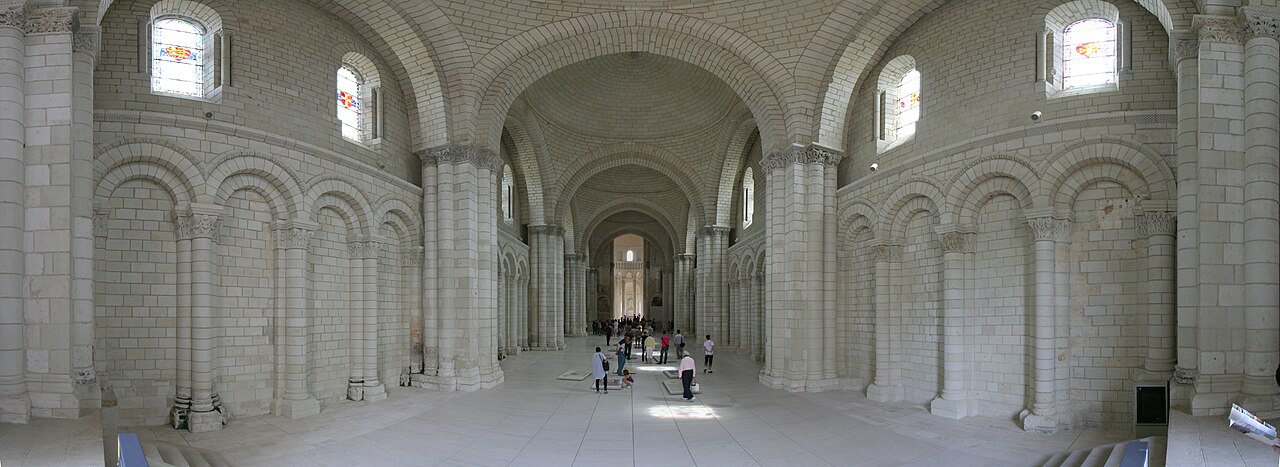
The emotional heart of Fontevraud lies in the nave of the abbey church, where the painted effigies of the Plantagenet dynasty are laid out side by side. Here you see Henry II, King of England and Count of Anjou, his wife Eleanor of Aquitaine — one of the most powerful women of the Middle Ages — their son Richard the Lionheart, and Isabella of Angoulême. Eleanor is shown with an open book in her hands, a striking detail for a queen. These polychrome effigies, among the rare survivors of their era, make Fontevraud the necropolis of a line that ruled over England and a large part of France. To stand before these stone faces is to look straight into the shared history of the two kingdoms.
The Romanesque kitchens, an architectural jewel
Among the curiosities of the abbey, the kitchens hold a place apart. This Romanesque building, crowned with an astonishing roof bristling with chimneys in stone scales, is one of the very few medieval kitchens in Europe to have come down to us. Its almost oriental form, its multiple hearths and its clever ventilation make it a fascinating piece of architecture, long interpreted and restored. One pictures the smoke of the fires, the bustle of the cooking nuns, the smoking of the fish. Children always look up, intrigued by such a singular silhouette. It is one of the most photographed buildings on the site, and one of the images you keep long after a visit to Fontevraud.
Fontevraud and contemporary art
Fontevraud is not a frozen site: it is a living place that converses with the creation of today. The abbey regularly hosts works and exhibitions of contemporary art that slip between the medieval stones, and a Museum of Modern Art, opened a few years ago, presents a rich collection in a dedicated building. This marriage of the Romanesque and the contemporary gives the visit an extra depth: you move from a twelfth-century effigy to a present-day installation without a jolt, as if the centuries were answering one another. This is what sets Fontevraud apart from many monuments: history is respected here without being embalmed. Do remember to check the current programme before you come.
The starred hotel-restaurant: sleeping and dining in the abbey
A rarity in France: part of the abbey has been turned into a hotel, and its table ranks among the recognised gastronomic addresses of the region. Dining beneath ancient vaults, in the former Saint-Lazare priory, is an experience of its own, carried by a cuisine that showcases the produce of the Loire Valley. For a stay at La Maison du Château, I see it more as an exceptional treat, for the length of a memorable lunch or dinner during your day in the western Loire. Book ahead, especially in high season. Whether or not you sleep there, taking a meal within these walls adds a sensory dimension to the memory of the place.
Combining Fontevraud with Saumur, Chinon and the surroundings
Fontevraud is earned by the road, so you may as well make it a proper day excursion. The village has a few good tables and the abbey easily fills half a day. All around, the territory is rich: Saumur and its château perched above the Loire, the troglodyte cellars and fine bubbles of the Saumur country, or the royal fortress of Chinon, some twenty minutes away, where Joan of Arc met the dauphin. Lovers of red wine will make a detour via Chinon or Bourgueil. By leaving Meung-sur-Loire early, you can pair Fontevraud in the morning with one of these sites in the afternoon, for a full day at the heart of Anjou and Touraine.
Practical tips for visiting Fontevraud
Allow around 1h45 of driving from Meung-sur-Loire, heading up the Loire Valley to the west: it is one of the more distant excursions from the house, to be planned accordingly. Set aside at least two to three hours on site to do justice to the abbey church, the cloister, the kitchens and the gardens. Good shoes are useful, as the ancient floors are sometimes uneven. Check the opening times and any seasonal closures before setting off, along with the current cultural programme. In November, visitor numbers are low and the soft light flatters the tuffeau stone beautifully: an ideal time to savour the place almost alone.
Fontevraud with the family and at your own pace
You might think the abbey austere: it is in fact surprisingly accessible to all ages. The vast spaces let children stretch their legs, the kitchens intrigue, and the interpretation on offer brings the history of the Plantagenets to life. Lovers of architecture and history find a rare density here, while those simply after a beautiful place to breathe are not let down by the gardens and the calm of the galleries. It is this versatility that makes Fontevraud a successful outing for a group of varied profiles, of the kind we often gather at La Maison du Château. Everyone finds their own rhythm, between contemplation, discovery and a gentle wander.
Necropolis of a royal dynasty, masterpiece of Romanesque art and a place of contemporary creation, the Royal Abbey of Fontevraud is one of the most powerful visits you can make from the Loire Valley. At 1h45 from La Maison du Château in Meung-sur-Loire, it asks for a proper day, but the reward matches the effort: a face-to-face with Eleanor, Richard and eight centuries of history.